part of Issue 02
Towards a
leaky lineage: (1)
eroding
mestizaje
Sofía Murillo Lommers
Groningen (NL), 2025
I walk through the Noorderplantsoen and admire the wild little weeds, planted by no one, often unnamed, and I laugh
at how their irreverence and disdain for order make me feel at home. It reminds me of my fi rst years in the Netherlands,
discovering that I was being perceived very evidently as other by Dutch white people, feeling out of place, like I
did not belong. I felt alone, insuffi cient, always aiming to be something I am not: White. Finally, I started dancing in
the Sterrebos and visiting the Drenthse-Friese Wold every chance I had. I found solace and kin in foraging berries and
mushrooms in autumn and Hawthorn fl owers every May. And for a couple of years now, swimming in every lake or
seashore I can find.
Throughout the years, I have found myself repeatedly questioning my position in relation to coloniality, specifi cally
the violent process that took place during the fi fteenth and sixteenth centuries in Abya Yala (known commonly as
Latin America) and which continues to be an issue. Being half Dutch and half Costa Rican with Black and Indigenous
ancestors, this process has many layers of unknowns about the past and question marks about my current relation to
Indigeneity and whiteness. In this written piece, I want to refl ect on my personal relationship with the term mestizaje
and on the perspectives of other thinkers on this topic as well as the process of blanqueamiento (whitening) of the
peoples in Latin America.
Being surrounded by friends working with ecology and social justice in Costa Rica, decolonization had already been
a topic of interest for me for a while, but it was only until I moved to the Netherlands that I started to deeply feel its
importance in my body. I could feel myself being othered. In Costa Rica, I grew up being perceived as not fully Costa
Rican because of my mom who is Dutch. This proximity to whiteness granted me a strange privilege that I did not realize
I had until I moved to the Netherlands and experienced myself without it. Since then, I have been wanting to better
understand my position within the web of power structures by not only reading and learning about decolonization and
anti-racism, but also by feeling the sensations in my body, the powers I am granted or denied depending on the context
I am in, and the painful spots that all these dynamics leave behind. I fi nd the distinction between decoloniality and
decolonization interesting and important in fi nding a position from which to exist. In Notes for Decolonizing Embodiment,
artistic researcher and scholar Ben Spatz (2019) describes the diff erence between these two terms. He explains
that while decolonization aims to dissolve the system of colonial rule, decoloniality, on the other hand, is the ongoing
praxis that unmakes the logics that uphold said colonial rule. He argues that decoloniality can attack coloniality via
cultural institutions due to its tactical and distributed nature (p.16). This distinction, for me, emphasizes the importance
of a daily personal practice within the process of dismantling systemic violence.
Growing up in Costa Rica, in secondary school, we learned about the colonial period, although we did not learn about
the material and social consequences it has had. Instead of highlighting the designed erasure of the autochthonous
richness and beauty of the Indigenous cultures, it is portrayed as a discovery of the Land by the Spanish and a coming
together of cultures, a beginning of an “enrichening process”. Often, there is no justice being made to the actuality of
it: a genocide of people, culture, and nature. A true loss. In fact, the fi rst time I learned what truly happened during the
colonial period was through a reggae song from one of my dad’s favorite bands, Los Cafres. In their song Pirata Colón,
which I grew up listening to, they sing:
|
“Vinieron en unos barcos Con barajitas del mundo viejo. Hace ya quinientos años Sufrió la vida un gran desprecio. La vida allá en Europa Es muy dorada a mí me contaron: Todo ese brillo robado Es puro oro americano. Y van pasando los años Y cómo cambian esos imperios. Nosotros siempre de abajo Con el corazón resistiendo” |
“They came in ships With playing cards from the old world. Five hundred years ago Life suff ered great contempt. Life there in Europe Is very golden they told me: All that stolen shine Is pure American gold. And the years go by How empires change. We’re always from below With our hearts resisting” |
Though many practices and aspects of Indigenous cultures have been thinned out severely and lost, there are Indigenous tribes that have resisted and survived. In the Costa Rican territory, the Indigenous People of the Bribri, Cabécar, Brunka, Huetar, Maleku, Gnäbe, Bröran and Chorotega tribes are actively in the process of reclaiming land, language, and ancestral practices. There are many independent processes taking place, as well as coalitions that span across the made-up borders that divide Abya Yala. I am not Indigenous. I did not grow up in an Indigenous community, and I don’t have the embodied experience of living in an Indigenous body and all the struggles that come with it. Regardless of this, I join countless non-indigenous Latin Americans in feeling deep grief about the loss of culture and richness that took place at the hands of colonizers. I also feel a sense of responsibility to help undo the power structures that I have also benefi ted from due to my proximity to whiteness. It is due to the awareness of both my closeness and distance to Indigeneity that I fi nd it extremely important to think deeply about my positionality and its relation to ancestry. Through the years, I have felt this question as a collision between having a clear intention and a murky path behind. The tangible consequences of the violence both infl icted on and by my ancestors, and the estrangement of having no record of how they looked, where they came from, or who they were. I am not able to trace my lineage accurately, as “It was not until 1949 that Afro-Costa Ricans obtained full citizenship. Many indigenous peoples were undocumented until the early 1990s” (Minority Rights Group, 2024).
Recently, while having a conversation with a friend on this question mark about my ancestors and my positionality, they mentioned the word “mestiza” when referring to a Latin American person, who like me, has a lineage of mixed race. All I know for certain is that I am half Dutch and half Costa Rican and that my dad has Black and Indigenous ancestors. I am dissatisfi ed with the word and the idea of identifying as mestiza. It is a vague categorization created by the Virreinato de Nueva España (Kingdom of New Spain) which attempted to obscure the complexity of the people as well as the racialized power dynamics behind the project of Blanqueamiento (Whitening); the ongoing “quest to escape from the ‘black’ in order to secure a better form of social existence in a context that values the ‘white’ as synonymous with progress, civilization and beauty” (Migoya, M.V. p,19).
Visual culture scholars Leihbson and Mundy (2005) note that the term was contextual to the caste system, which utilized bloodlines as one of the leading criteria to distinguish people and was a pillar in the formation of hierarchies within the colonies. In the image of the painting Cuadro de Castas by an anonymous (colonial) painter, it is possible to see: 1) the categorization and naming of the diff erent ways bloodlines interacted by colonizers, and 2) how homogenizing it is to use mestizo for any or all persons of mixed heritage. Additionally, the word “Mestizo” appears in a seventeenth- century Spanish dictionary and is then defi ned as the mix between diff erent species of animals; a challenge to natural order and a dilution of a pure bloodline (Leihbson, D. Mundy, B. 2005), which awards the term a negative, degrading connotation.
In my process of searching for perspectives on the word mestizo and the process of mestizaje, I came across varying refl ections. In Rethinking Mestizaje: Ideology and Lived Experience, social anthropologist Peter Wade (2005) describes mestizaje as a complex phenomenon that contains “tensions between sameness and diff erence, and between inclusion and exclusion” (p.240). He explains that mestizaje is seen both as a “discourse of nation formation” (p.241), a fabricated “citizen” which through homogenization erases both indigenousness and blackness, and as a “liberating force that breaks open colonial and neo-colonial categories of ethnicity and race” (p.242).
He shares the example of Gloria Anzaldúa’s New Mestiza and Marisol de la Cadena’s Indigenous Mestizos, who reclaim mestizaje and place it in a position of resistance, essentially challenging Western authority. He notes that the focus on mestizaje as “potentially subversive” is likely to have its roots in theories about hybridity that propose it as a “symbolic process which unsettles hierarchies, orthodoxies and purities, creating a ‘third space’ outside binary oppositions.” (p.243) Although the concept of reclaiming a name or word is not unfamiliar to me (I also call myself queer), the idea of claiming mestizaje as my own is still diffi cult. The thoughts of Angie Farfán in Habitar el cuerpo enemigo: mestizaje y el no poder nombrarse (n.d) resonate with me. El no poder nombrarse, being unable to name oneself. In her text, she expresses her resistance (which I share) towards naming herself mestiza, a term which was forged in the context of colonization and utilized as a weapon within the strategy of blanqueamiento. She affi rms that negating diff erences and homogenizing them does not put an end to the reality of them. I think we share a sense that adopting mestizaje as own furthers the process of homogenization of Latin American people and fl attens down conversations about our diverse embodied experiences and dynamics of power.
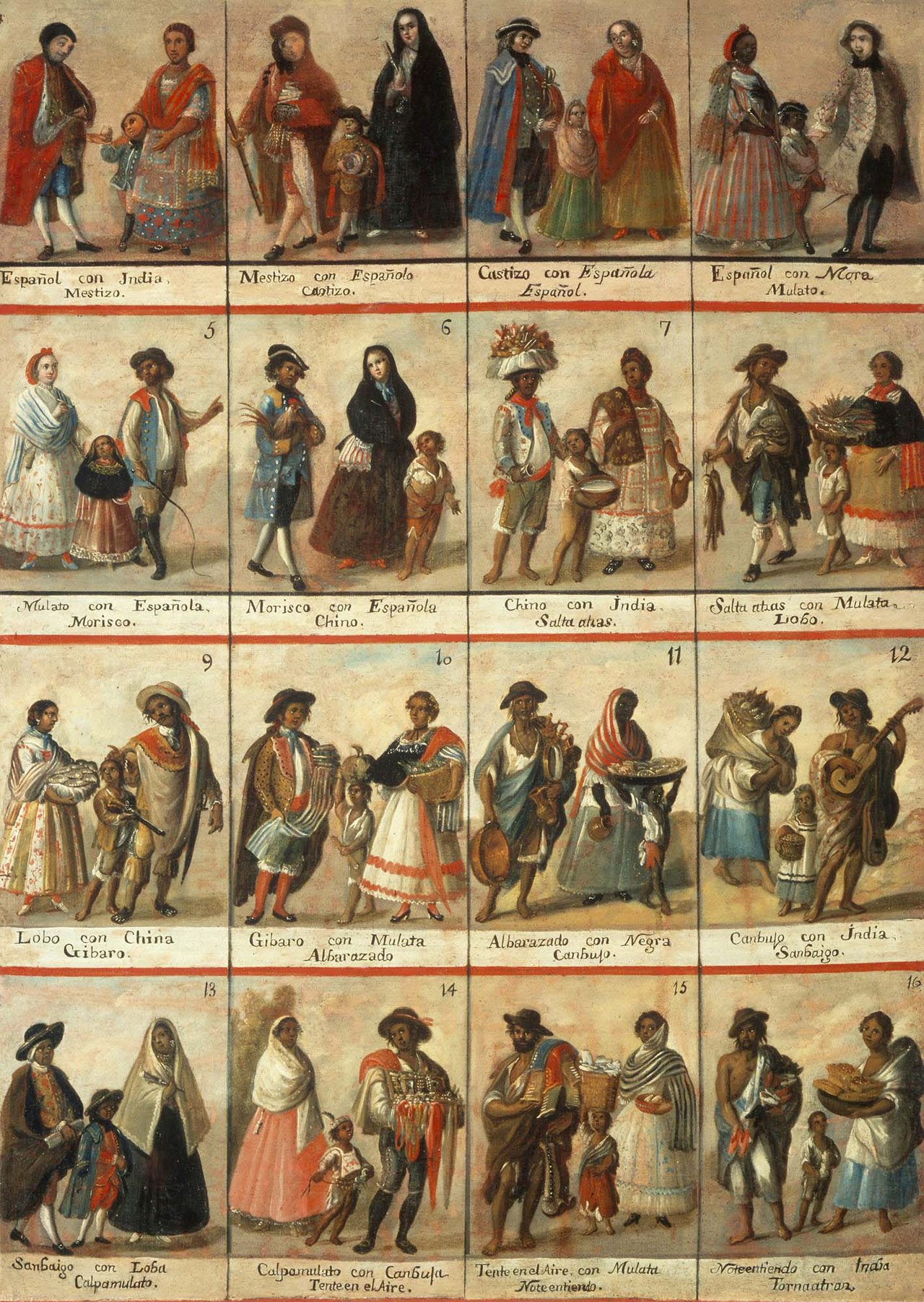 Anonymous artist, Cuadro de Castas, 18th cent.
Reading Farfán’s thoughts has made it clear that within mestiza I cannot fi nd a naming or position that truly resonates with and encompasses my embodied experiences. I have had the intention for this piece to be the beginning of an ongoing research, hence the 1) in the title. Although I have been thinking about my positionality and ancestry for many years now, this is the fi rst time I have had the space to intentionally dive into the topic, writing a piece about it. Moving forward, I would like to gather insights by practicing embodied and aff ective methodologies alongside reading about other Latin American perspectives on heritage and lineage through a hydro-feminist lens. I am excited about where this will lead me. I want to create a lineage for myself, one that is porous and disruptive of the confi nements imposed by colonial violence, able to go beyond the given boundaries of who and what I can include in my family tree. I want to claim the power to fi nd and name my family through my body, my senses, exploring rivers, foods, tastes, while listening and connecting to people.
As I finish writing the last words on these pages, I am on the Bree Sant, a sailboat built in 1905, on which we have been sailing for 5 days. Looking out towards the ocean, I realize more and more how much I miss home. I imagine, when I am in the sea, that there are at least two drops of water that came from the mountains of the Talamanca Mountain range, through the Pacuare river, into the Caribbean Ocean, over the Atlantic, and up into the North Sea, pulled to the Wadden Sea. I imagine when I sing underwater, that my chants travel all the way back and make it to the top of those mountains again, where the water that has touched me was born.1
Me preguntas por mi sangre
Si indígena, nativa,
Si bastarda o mezclada
Y yo solo la siento hirviendo
Cocinándose por 500 años
Yo solo la veo
Regándose, escapándose
De vuelta a la tierra.
-Farfan, A
Notes:
1 You can listen to these chants on Not @ Home Radio - Cantos para la MarSources:
Farfán, A. (n.d) Habitar el cuerpo enemigo: mestizaje y el no poder nombrarse.Retrieved from https://recodo.sx/habitar-el-cuerpo-enemigo-mestizaje-y-el-no-poder-nombrarse/ in April 2025.
Migoya, M.V. (2016) Blanqueamiento social, nación y moralidad en América Latina. SciELO Book. EDUFBA. https://doi.org/10.7476/9788523218669.0002
Minority Rights Group. (2024, 9 April). Costa Rica - Minority Rights group. Retrieved via https://minorityrights.org/country/costa-rica/ in May 2025.
Leihbson, D. Mundy, B. (2005) Contemplando Mestizaje. Vistas: Visual Culture in Spanish America, 1520-1820.
Retrieved from www.smith.edu/vistas/vistas_web/espanol/units/surv_mestizaje.htm in April 2025.
Portocarrero, G. (2013) La utopia del blanqueamiento y la lucha por el mestizaje. Hegemonía cultural y políticas de la diferencia. CLACSO, Buenos Aires.
Retrieved from https://biblioteca.clacso.edu.ar/clacso/gt/20130722095432/Gonzalo_Portocarrero.pdf in April, 2025.
Spatz, B. (2019). Notes for decolonizing embodiment. Journal of Dramatic Theory and Criticism, 33(2), 9–22. https://doi.org/10.1353/dtc.2019.0001
Wade, P. (2005) Rethinking Mestizaje: Ideology and Lived Experience. Cambridge University Press, United Kingdom.
Retrieved from https://personalpages.manchester.ac.uk/staff/peter.wade/articles/JLAS%20article.pdf in April 2025.