part of Issue 02
Snacking Together
Jorien Ketelaar
Groningen & Rotterdam (NL), 2025
Within this text I am sharing my research on snackbar culture in the Netherlands, which is coming from several projects I’ve been doing this past year related to snackbars and snacking culture. Within the text I am going from the history of the snackbar to the role in Dutch culture and everyday life, to what the snackbar can be for individuals and a community relating it to two projects I’ve been doing.
For me, the local snackbar* is an indispensable part of the Dutch streetscape and food culture. It’s a nostalgic place, where many get a snack or dinner once in a while. Researching the history of snackbars, I learned that in the 1930’s1, during the economic crisis, lunchrooms needed to change their concept and came up with a fast way of snacking standing up or while walking. Not just the snackbar, but also the snackmuur (wall with snacks)
became popular. I learned that the croquet caused a top-down and bottom-up dynamic, as it was mainly eaten by the bourgeoisie but now available for everyone in the snackbar, which made it a respectable place for everyone to be. In the 50’s and 60’s fries became popular among youngsters, and transformed snackbars into their
meeting place. Authorities were concerned the snackbar would become a starting point for rebellious behavior where young people inspired each other to act against the system.2 And maybe it was, still is, or could become again?
Although fried snacks are not particularly healthy, the snack bar’s waiting area often serves as a meeting place for the neighbourhood, which can contribute to
a healthy community.
The local snackbar is a place to get food, but also to meet neighbors. Most neighborhoods and villages will have their own snackbars, often owned and run by locals. While waiting, there is time and space for small and unexpected encounters. I read3 that a feeling of safety in public spaces is often related to the places around where brief encounters can take place, and that this contributes to public familiarity: a certain degree of trust in a neighbourhood by creating space for shared experience among people who do not know each other, who do not share much and do not do much together, but who together form the neighbourhood. Local snackbars emerged from a logic of speed, efficiency, and profit. But they also produce moments of lingering familiarity, shared rituals, and intimacy between strangers.
Can these brief encounters, in a place designed for quick consumption, carry a quiet resistance to the alienation of capitalist life, not necessarily by rejecting its systems, but by making space for connection? In Smooth City, Renee de Boer writes about the increasing urge for perfection, efficiency and control for a city with no friction. He writes that ‘this new version of urbanity undermines the democratic nature and the emancipatory potential of cities, and hardly leaves any space for experiment, non-normativity and transgression.’ It excludes those who don’t fit in with the expected by not making them feel welcome and by eliminating space for anything that is experimental or incompatible with dominant norms. The local snackbar however seems to slip in between this and stays a place that is welcoming of a big variety of people.
In Rotterdam oude-westen you find snackbar Frieda;
a snackbar in a squat where you can snack on donation. Here they make fries from potatoes that are left behind on the fields after the harvest. Besides serving fries, they open the snackbar to anyone in need of a space for non commercial events based on relevancy to grassroots activism and accessibility to people from the neighbourhood and city.
With our collective mul-thee-fuhngk-shuh-nl we gave the workshop ‘Fries Forever’ in which we were making fries from clay at Frieda. Most of the participants were people waiting for their fries, sitting down for 10 minutes joining the conversation. During our workshop, about half of the participants were people waiting for their fries so they would clay and chat with us. During the claying we spoke about ownership of (public) space, reclaiming (public) space and creating new spaces to meet, like Frieda does. Parts of these conversations were written in the fresh clayed fries with vermicelli letters, leaving an imprint behind after burning the clay pieces. With the burned and glazed fries we made a public fry-route, super glueing the fries in public space around Frieda reclaiming it and spreading our conversation, making Frieda’s fries stay forever.
The other project we did this year was in the summer, when we took over the former snackbar de wachtkamer in Groningen, NL. This building, once opened as a café t’ jonge tijgerpaard in 1954, got turned into a local snackbar in the 70’s, until it got shut down by authorities in 2022. Since then the building has been empty and fallen into disrepair. The building is situated in between two roads, surrounded by cars, houses, and people walking their dog. It has big windows, which makes it feel like an aquarium. After a phone call with the owner to ask if we could take it over during the summer to host artists to transform the space, we received the keys and started cleaning. Although we sprayed liters of degreaser on the walls, there was still a layer of dark brown grease revealing its frying history. Within this space, together with Indira de Boer and het resort, we hosted four midweeks for artists to join and work collectively, and four Fridays opening the space for anyone curious. After that, the building is being renovated and made into a lunchroom.
Within the project at the former snackbar de wachtkamer, inspired by what kind of place a local snackbar can be, we wanted to create space for connection, care and community for artists, neighbors, friends and passers by. During the midweeks artists could use the space as a site to produce work, hang out, exchange ideas, read, talk and eat together. With their presence and their work they transformed the space and collectively reinterpreted its use. During the Fridays the space was open for all to come by, hang out and see what was made during the midweek.
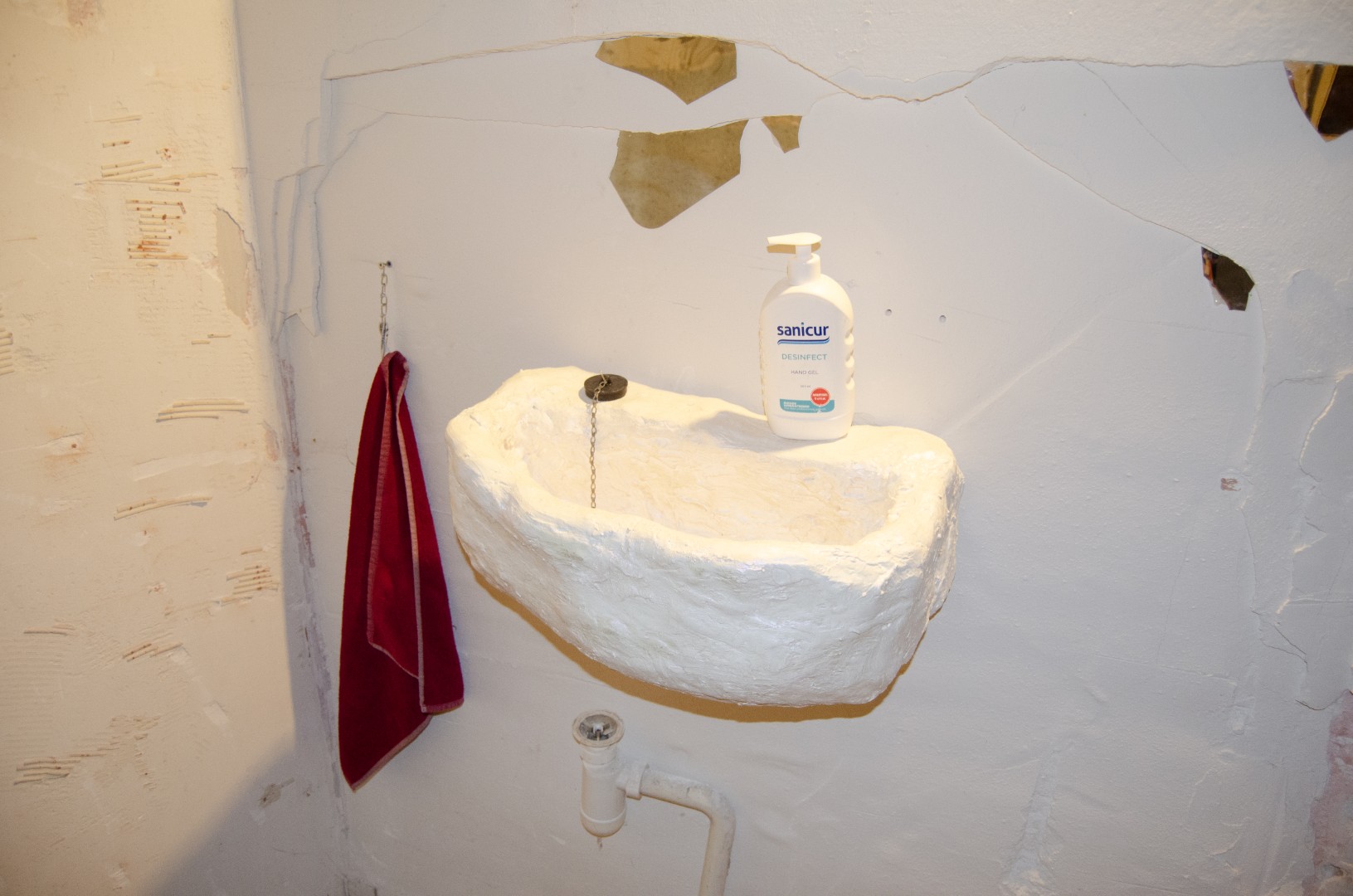 Indira de Boer & Jorien Ketelaar, a summer away from running water, plaster, metal wire, drain plug, towel, mirror and lamp.
photo by Djordi Komrij.
Indira de Boer & Jorien Ketelaar, a summer away from running water, plaster, metal wire, drain plug, towel, mirror and lamp.
photo by Djordi Komrij.
For example, Julia de Jong and Yvonne Blaauw made a petanque court in the grass on which neighbors played together with artists and others on Friday afternoons. For Marijn it was a place where she tried out for the first time a performance that was not music related, and for Marijke it was the first time to do a performance that was music related. For a collective of four it was a site of expressing their need for drinking tea with friends instead of alcohol by creating a cozy environment with mattresses on the floor, on which strangers sat intimately together drinking tea. For Frans van Hoek it was a space to create a stock market, in which the audience could decide when to sell and when to buy €100 on the U.S. stock market. And Cian Ti served fries last Friday along with selfmade sauces that related to poems she wrote after guests who stayed with her. Together with Indira we made a deconstructed bar, taking bar elements and making them into dysfunctional collages. We also made a sink out of plaster, as we had no running water, to emphasize the absence of it.
By creating space for people to encounter each other and something unexpected, we aimed to generate alternative imaginaries on everyday life, the use of space, and on capitalist frameworks that constrain our behaviours and interactions, using collective playfulness as a form of creative resistance against the consumer attitude that has always ruled here.
The stories of the neighbors memorizing the snackbar as it was, us doing projects in snackbar relating spaces and reflecting on the role of the local snackbar made me understand the local snackbar as places of community, of connection and of understanding. Maybe, very maybe, the local snackbar is one of the pillars of Dutch society - to meet, eat and speak.
notes:
* With local snackbars I mean snackbars run by locals situated in the neighborhood, often a family business, that is not a franchise.1 www.klasienhorstman.nl/debat/gezonde-stad-en-buurt/patat-shoarma-en-zuurvlees-de-snackbar-en-de-sociale-infrastructuur-van-de-stad/
2 www.isgeschiedenis.nl/longreads/snacks-snackcultuur-en-buitenshuis-eten-in-nederland-1920-1980
3 www.taljablokland.com/wp-content/uploads/2024/11/Blokland_2009_Het-belang-van-publieke-familiariteit-in-de-openbare-ruimte.pdf