part of Issue 02
Toward a Clumsy Theory of Re-Enactments as Epistemic Compost
Klaudija Ylaite
Groningen (NL), 2025
Writing about something that takes place in our bodies is a task I have been struggling with. At first, it seems that language, being perhaps the most common form of human communication, serves as an easy route to put words on actions done. Yet, when it comes to the lived, the injured, sweating, and resisting body, language starts to feel like a second-rate translation. And still—I write. Not to seal the body but to weave a rhizome stretching to weird horizons I have no word to name. The wish to write is a rehearsal of proximity and repetition of the clumsy elegance of theory.
This brief text is about my love of performance art, my admiration for ritual practices, and my commitment to pushing the epistemological frontiers by advocating embodied knowledge production. By epistemological frontiers, I refer to the shifting boundaries of what counts as knowledge, in turn, placing embodied knowledge, where the body becomes a site of knowing; inseparable from thought, movement, and lived experiences. It is also about my confusion in walking on thin perimeters between theory and practice, thinking about how to theorise without sucking the vibrant vitality from the thing being theorised.
To navigate this mossy terrain and to make it exciting for myself, I plant re-enactments as a conceptual and methodological sprout in the soils of performance and ritual. This is my wish to re-enter, re-trace, and re-situate meanings, gestures, and bodies within the ritualised performance. In this damp soil, re-enactments become a converging ground for my ongoing investigation into creating new methods for embodied knowledge production. This investigation is rooted in a mode of research where meaning unfolds through repetition and sensations. All this planting and sowing is followed by my growing resilience towards the pests of the Western dualistic mindset and oppressive regimes. It is no news, for us, artists, researchers, cultural workers, and those who wish to seek beyond given systems that Western knowledge, driven by imperialist patriarchal and colonialist power structures, has placed a value on objective, universalising accounts that have for centuries suppressed and dismissed alternative ways of knowing. It is the well-known Cartesian ghost story where the mind floats above and the body is reduced to matter in need of control.
However, I do not wish to disregard the colossal legacy of I think, therefore, I am, rather to unearth its parched soil, tend to it with care, and slowly turn it into compost. A compost for the clumsiness of thoughts and moving bodies. Thus, when referring to epistemologies, I do not refer to knowledge per se1; rather, I take the means of epistemology as systems that discipline, codify, and legitimise certain modes of knowing. My constant usage of this term is rather to bring in tension by underscoring how Western structures codify what counts as knowledge.
One way to begin to step outside the Western epistemes is to acknowledge that my knowledge is relational and situated; emerging from specific positions and meshed through encounters with others—human and more-than-human alike. Thanks to the richness of feminist movements, Indigenous philosophies, and environmental thinking, which have recalibrated me to think outside the Western epistemes. Thanks to friends, colleagues, and teachers who brought me closer to the understanding of interconnected existence. Yet, still, I have much work to do, many seeds to gather, and many furrows to dig and plant those seeds.
As I will now begin weaving words into sentences for this clumsy theoretical elegance, I keep in mind that such formulation will inevitably cause a counteraction, for which I am open to exchange.
My weaving begins with how I found how my own body ritualised in performance acts. Building each performance following a loosely scripted mental score, I noticed how each performance reverberated the previous one. Not in the concepts I would be dealing with in performing, but rather material, object-oriented assemblages, and my body's repetitive, stylised movements. Those included having the performance take place in a protective circle2, be it on an elevated stage, by drawing a salt circle, or simply with the movement through space claiming a circle. Each performance would include a charged thing; an object with its own independent meaning, be it water, soil, bones, ropes, something living or dead, or simply a book. Lastly, my stylised body would follow repetitive, at times exhaustive, endurance-led movements that would calibrate and heighten my presence towards and awareness inwards the emerging embodied meaning. All these performative acts would reach their ends when my body would be exhausted, either collapsing to prevent injury or entering a state of full suspension.
Inevitably, what you are hearing from my performative experience can resonate with a couple or more performance art genres that emerged in the last century. I lean toward the neo avant-garde endurance art tradition, notably visible in the works of Viennese Actionists, who worked within the tradition of endurance; pushing the limits of the body and treating it as a medium of art and political expression. As well, the second-wave (eco)feminist artists, such as Mary Beth Edelson and Suzanne Lacy, who webbed the body’s expressive and political capacities into the relations of ecology and ritual.
However, these particular art historical gestures of performance art are an artistic wish to inscribe oneself into a particular furrow. This is mine; a provocative lineage that challenges the spectacle and embraces the vulnerable. As Sólveig Guðmundsdóttir, a researcher on the (neo)avant-garde and particularly Viennese Actionists, writes:
“[t]he Actionists employed various materials for their artistic creations, including food, animal blood, carcasses and guts, bodily fluids, and excrement. The body was the principal material, the instrument, and the subject of the Actionists’ art. They believed working intimately with the body through performance offered a closeness to the real that no other art form could replicate” (6).
That desire to come as close to the body and its mysteries, as Guðmundsdóttir states when writing on Viennese Actionists, is something that has affected and resonated in my elementary understanding of utilising performance art. Yet, while the neo-avant-garde introduces the body as a radical site of resistance towards the spectacle, I want to situate such performative renderings outside the art historical canon. Since, in the end, my commitment lies in expanding modes of knowledge production. Like Edelson and Lacy, I extend the body to the relational networks situated outside the white walls of art institutions, where performance becomes a way to tend the soil of knowledge, composting inherent frameworks so the new modes of knowing can sprout.
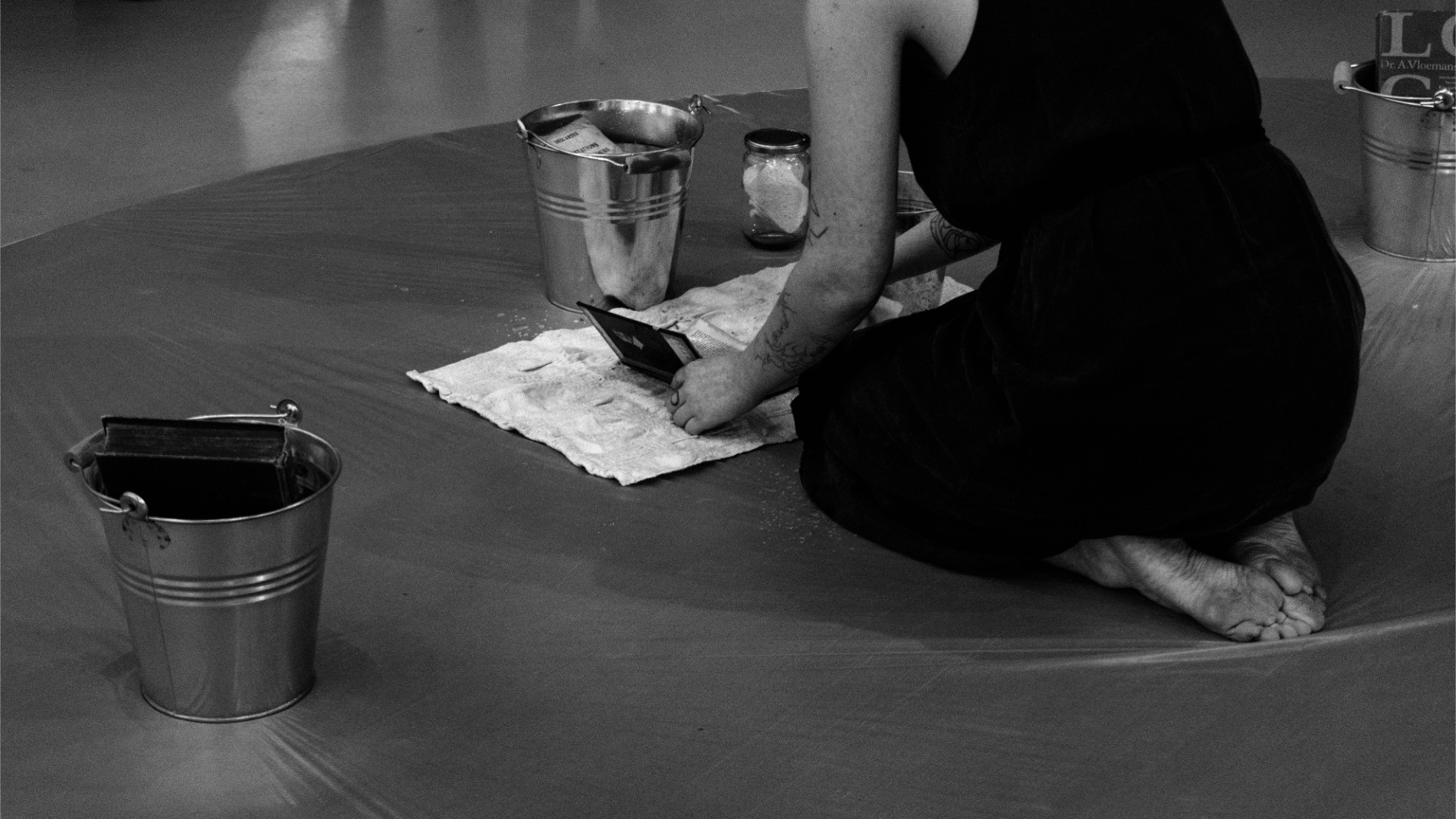 Klaudija Ylaite, Cleanstorying, 2024, photo by Michiel Teeuw
This composting, which (eco)feminist artists began, brings me back to weaving. Weaving in rituals. I recall, in 2024, during the Night of Philosophy, on the 19th of April, I was kneeling and washing Western philosophy books. The audience, who came to listen to Western-based philosophers, could watch me washing. I knelt and soaked seven books in water for two and a half hours. This was the performance that stepped outside being a mere representation of my critique and anger towards Western epistemologies; it stood as a ritual in which I negotiated the fine line of destruction and renewal. It was a ritual in which the water I used resisted my conceptual implications –the ink did not wash off from the books– but rather became my collaborator in re-thinking and shifting my critique. I found myself partaking in a ritual of unlearning –all that was mentally loosely scripted and prepared for the performance was gone.
Since then, I have treated performance art and ritual practice interchangeably, both in theory and practice. Now, allow me to briefly guide you through the clumsy terrain of theories of scholars who have neatly contextualised ritual as a mode of knowledge, embodiment, and resistance. Their work provides a scaffold for my exploration.
I begin with Ronald L. Grimes (2000), a professor emeritus in the department of Religion and Culture at Wilfrid Laurier University in Waterloo, Canada, and the author of numerous books on ritual studies. In one of his books, Deeply Into the Bone: Re-Inventing Rites of Passage. Life Passages (2000), Grimes defined rituals as “sequences of ordinary action rendered special by virtue of their condensation, elevation, or stylization” (21). Grimes' contextualization has served as my starting point for comprehending how ordinary, physical acts may function as places of inquiry and meaning-making when these actions are repeated and intensified. So to say, the action becomes ritualised.
However, I have taken Grimes’s contextualization and extended my textual comprehension of rituals to cases where rituals are treated as sites of anticipation and resistance. For the concept of anticipation, I followed a phenomenological account of Jack Williams’s (2023), a philosopher with interests in philosophy of religion, phenomenology and philosophy of mind. According to Williams (2023), since performing ritual acts involves exposing the body to a specific position(s) for a predetermined period(s) of time, it exposes the body in such a manner, causing a participating individual or community to “begin to anticipate perceiving the world in a new way” (111). Anticipation in this manner signals that perception is not limited to the immediate rational explanation of appearance but is an embodied possibility to alter how we perceive the world.
As for the resistance side of rituals, I have followed Peter MacLaren’s3 (2022) critical theory on pedagogy. MacLaren codifies rituals as sites of resistance as “attempts at ‘purifying’ the contaminated and fragmented world of institutionalised social structure. They may be aptly described as a type of ceremonial 'destructuring” (42). Rituals of resistance, based on McLaren (2022), seek to undermine and rethink the structures that determine social and epistemic order as opposed to simply restoring harmony. This happens due to ritual acting outside the frameworks of rationality and codification favoured by dominant Western epistemologies. Thus, McLaren’s notion of ceremonial destructuring stands as an act of retreating from the imposed epistemic order by subverting it into modes of resistance. I read this concept of destructuring through the very same composting; repeated gestures over hours transform inherited hierarchies and rigid knowledge structures into loamy material.
The anticipated and repetitive physical acts teach us new things about our surroundings, about particular symbolic and/or material meanings, and our situatedness in the world. In this regard, the body, just like in the performance, becomes one of the main parts of the whole act. I position the body as one of the actors in the whole of the act, as I leave the entrance open for all things vitality.
Repetition and endurance allow gestures to sediment meaning, while the presence of the persistent forces, be it books, water, soil, or sites, shape and transmit knowledge over time. The body is not alone in space. I take notice of object-oriented4 assemblages and how objects of rituals inform and transmit their meaning. When thinking about how rituals have survived and persisted, it becomes evident that certain objects are repeatedly utilised across cultures, times, locations, and belief systems. While their assemblages or symbolic meaning might have altered over time, the knowledge they carry appears to be intact. This is what a wonderful anthropologist, Anne-Christine Hornborg (2017), has named interrituality. Hornborg, after being-with the Mi'kmaq First Nation in Nova Scotia, wrote on the means of interrituality as follows:
“To invent a ritual is not a matter of only picking acts or elements from ones imagination and putting them together; it is a question of careful choices of acts which are already given and defined as “traditional” practices. These already well-known acts (or utterances) from other rituals are rearranged within a new frame. By reusing these already familiar acts as building blocks it is also easier to introduce new ones without disturbing the sense of a ritual being “traditional” (17).
What Hornborg’s observation presented to me is the understanding of ritual continuity that takes place first through our embodied presence and second, by the vital objects that persist in time and space.
It is within this layered field of repetition, rearrangement, and bodily anticipated engagement with the space, objects, and all that is vital around us that I think-with re-enactment as my final weaving thread. A thread that brings ritualised performance gestures towards continuity through difference. Re-enactments as continuity, which invites transformation, a gesture which provides inherited practices to feed new epistemologies without erasing their histories. Re-enactments as composting sites of knowledge in a soil rich with alternative ways of knowing and grounded in embodied experience.
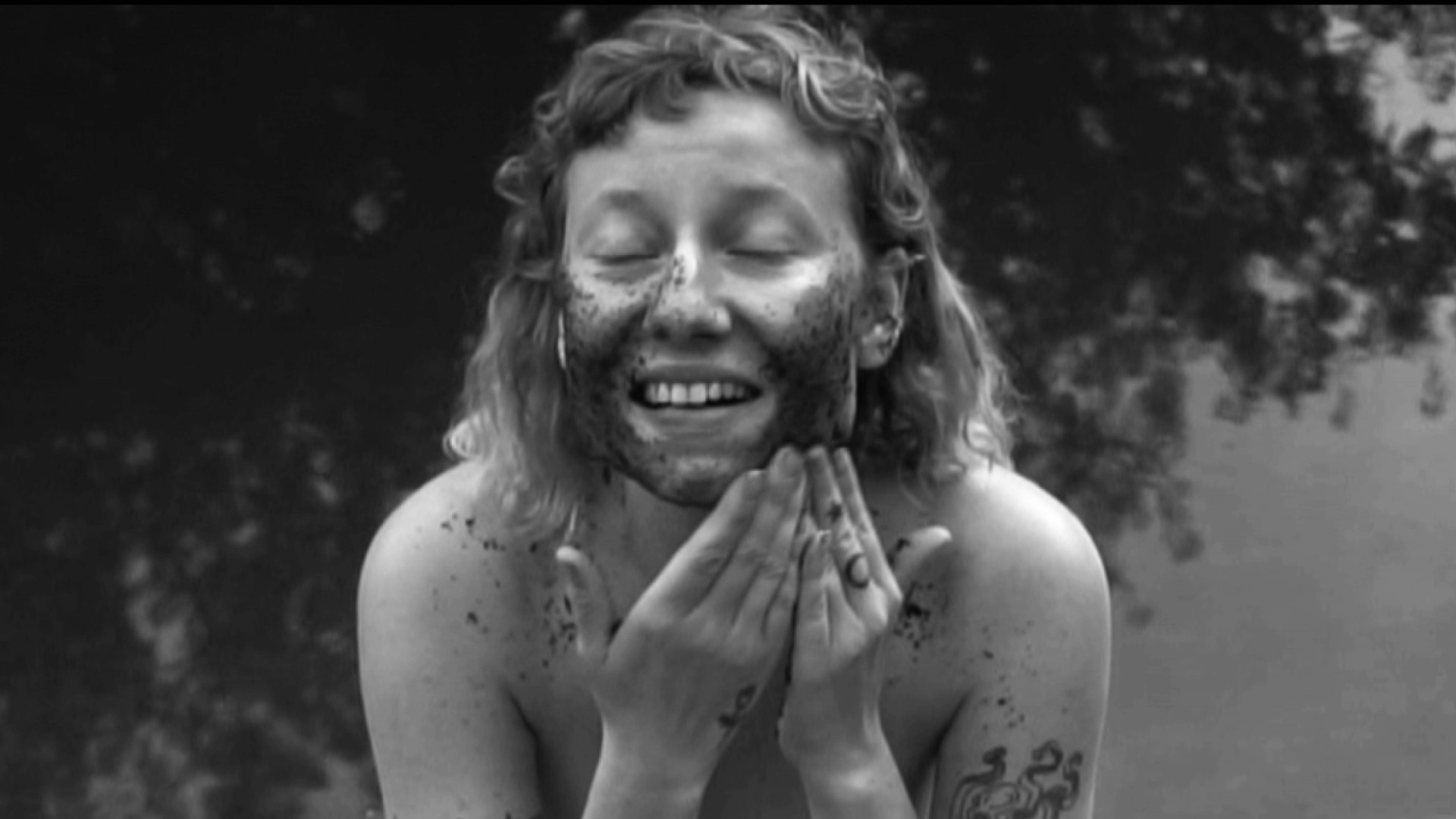 Klaudija Ylaite, Art must be ecological. Artist must be eco-friendly.
After Marina Abramović, Art Must Be Beautiful, Artist Must Be Beautiful, 1975.
Recently, having access to the world library, and spending hours just typing keywords, scrolling page after page, I stumbled across Reenactment Case Studies: Global Perspectives on Experiential History (2022), a book which situated re-enactments as a global phenomenon, raising a question of how experience-based historical knowledge-making relates to memory-making and politics. In the introduction, Agnew et. al. (2022) define re-enactments as follows:
“Reenactive practices aim at copying the past using strategies of citation, repetition, mimesis, and performative approaches. <...> From an epistemological point of view, the past is irrecoverable, and every restaging of prior events or dispositions is inevitably an interpretation rooted in present-day values and norms. Thus, notwithstanding reenactors’ efforts to collapse temporalities and evoke the past in the present, a repetition is always a renewed, reinterpreted, and revisited version of the past” (4).
Agnew et al.'s grounding of re-enactments provides an understanding of them not as a reconstruction or nostalgic longing but rather as an indication of how epistemic residues buried in past gestures can be used as compost for new soil. In this line of thinking, I propose to think of re-enactments as an embodied method of letting the past decay and re-emerge in the present. In this way, re-enactments are living processes of epistemic development; by simultaneously enacting and knowing, they constitute both practice and theory.
This method of re-enactments is where, currently, my endeavours in ritual and performance practice come together. In this convergence, ritual functions as a carcass, a frame for an engagement with temporal yet affective disorientations. As MacLaren (2022) puts it, rituals functioning outside the established norms of what is knowledge become sites of resistance. In performance, the ritualised body that enacts embodied knowledge presents itself through repetitive, anticipated stylisation of the act. Taken together, this triadic constellation of ritual, performance, and re-enactment stands as an embodied methodology that refuses linear historiography and codified representational closure. Thus, in closing, if epistemology is to move beyond the Cartesian parable, it must take up methods that are bodily, temporal, and material.
This clumsy theory is unapologetically unfinished.
Endnotes
1. By per se I mean knowledge as information, facts, or skills in themselves.
2. a circle formation, is said to provide protection, contain ritual energy, and keep the focus of the extraordinary act that is taking place (Starhawk [1999] 2011).
3. Peter MacLaren is a scholar known as one of the leading architects of critical pedagogy.
4. For those in the fields of environmental humanities and the philosophical framework of new materialism, Harman's theory of object-oriented ontology is considered as a key tenet. Object-oriented ontology rejects conventional hierarchies that place human cognition and meaning-making at the core of knowledge production by asserting that all objects, living or non-living, have their own agency and are capable of escaping human comprehension.
Bibliography
Agnew, V., Tomann, J., & Stach, S. (Eds.). 2022. Introduction. Reenactment Case Studies: Global Perspectives on Experiential History
(1st ed.). Routledge. https://doi-org.proxy-ub.rug.nl/10.4324/9780429445668
Grimes, Ronald L. 2000. Deeply Into the Bone : Re-Inventing Rites of Passage. Life Passages.
Berkeley: University of California Press. https://search-ebscohost-com.proxy-ub.rug.nl/login.aspx?direct=true&db=nlebk&AN=66382&site=ehost-live&scope=site.
Hornborg, Anne-Christine. 2017. “Interrituality as a Means to Perform the Art of Building New Rituals.” Journal of Ritual Studies 31 (2): 17–27. https://www.jstor.org/stable/44988495.
McLaren, Peter. 2022. Critical Theory : Rituals, Pedagogies and Resistance. Leiden: Brill.
Sólveig Guðmundsdóttir. 2024. Subversive Esotericism and Aesthetic Radicalism. Palgrave Macmillan Cham. https://doi.org/10.1007/978-3-031-74017-6.
Starhawk. (1999) 2011. The Spiral Dance. 3rd edition. Harper Collins.
Williams, Jack. 2023. “Embodied World Construction: A Phenomenology of Ritual.” Religious
Studies, February, 1–20. https://doi.org/10.1017/s0034412523000033.