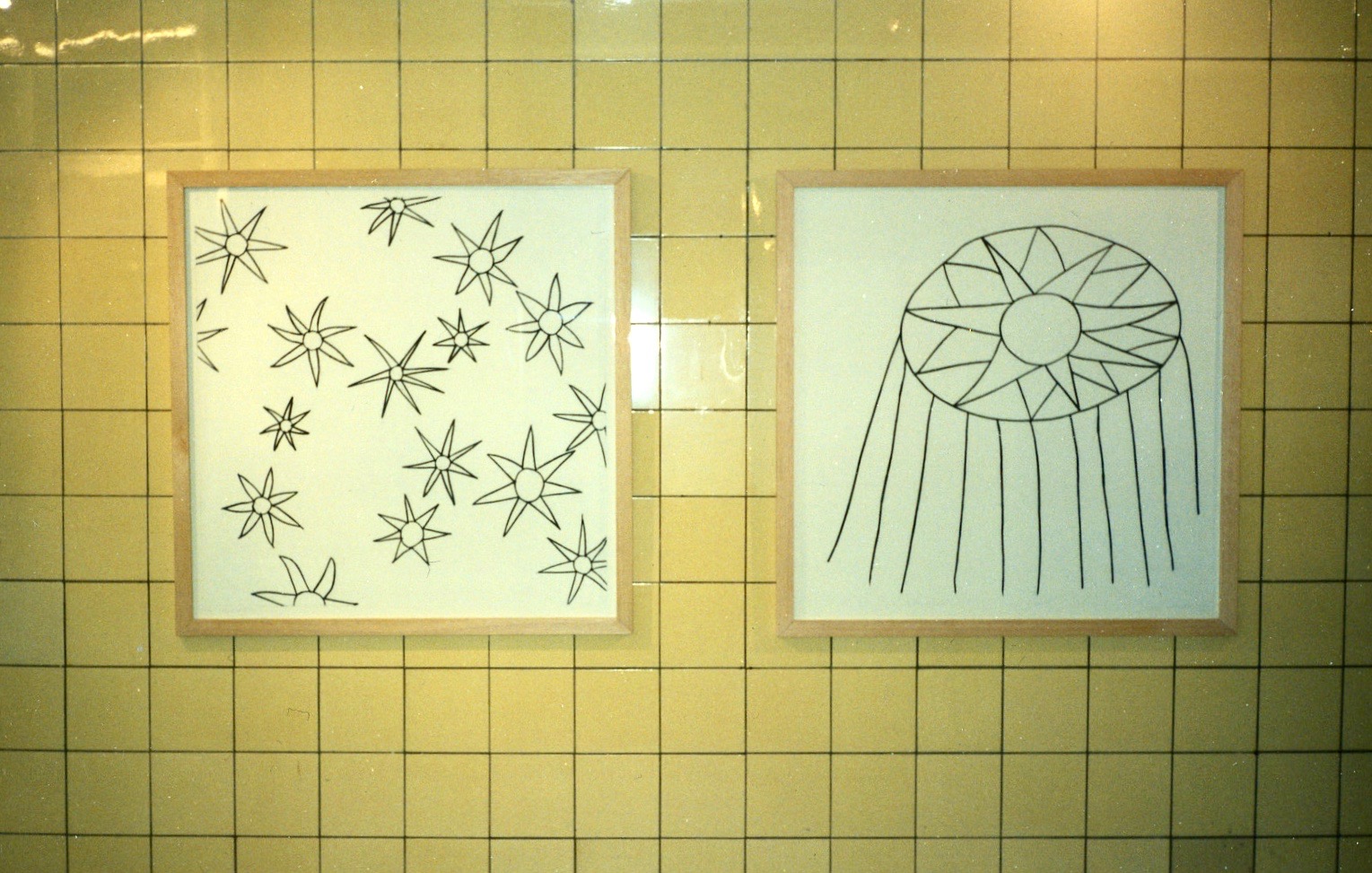
part of SIGN 1988-2018 (WIP)
ZONNEWENDE
Janwillem Jagers on Yoni de Groot - 1992
On the occasion of the opening of the exhibition by Yoni de Groot on 16-5-1992 in the Groningen gallery "Sign", I would like to write something about a drypoint etching called "Zonnewende" that hangs there.
I will begin by describing the space where this etching is exhibited. Gallery "Sign" is located in an old butcher's shop. This is still visible through the tiled walls and the layout of the space. A large space that was probably the shop in the past and where a work table is still located at the back of the space. Above it there is a window that looks out onto a small space behind it, of which all walls are also covered with tiles. Through the window, the drypoint etching "Zonnewende" is visible, hanging on the opposite wall. Daylight falls diagonally from above onto the etching. Probably a combination of factors is responsible for the fact that I am writing this paper about "Zonnewende". The etching itself in the first place, the space in which it hangs, the daylight that falls diagonally on it (probably through a window in the ceiling), also the reflection of the window through which I saw the etching.
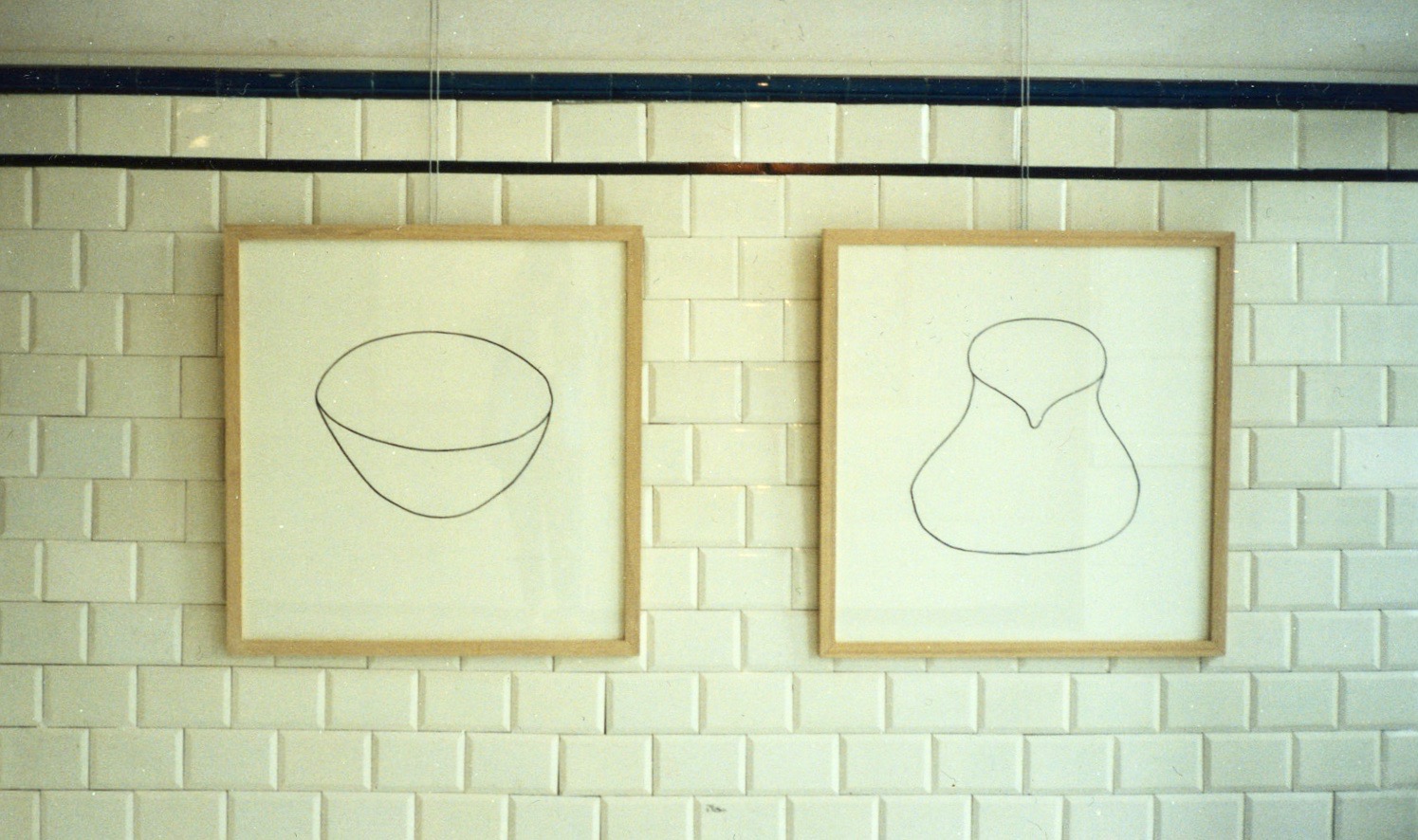
That which I have been calling one drypoint etching is actually one image consisting of a large etching surrounded by 12 small etchings. All are framed in a wooden frame with glass in front. The large etching (size 50 x 50 cm.) hangs in the middle. The 12 small etchings (size 25 x 25 cm.) are grouped closely around it, so that all the etchings together form one large square.
On the large etching, a stylised flowerpot is shown from the side. Only the thick black lines on a white background are visible, which together form an earthenware flowerpot in side view. Although there is no depth in it, the shape is still correct; it merely shows the contours as it were, with the exception that a line runs through the image indicating the rim of the flowerpot. The flowerpot is upside down. The 12 small etchings around it each show three concentric circles. A small circle with a larger circle around it and around that, at equal distance, another larger circle. These circles also consist only of thick black lines on a white background.
The combination of the side view of the flowerpot with the small circles suggests that these circles are the top view of the flowerpot, if it were not upside down. Each top view is different, although at first glance they look the same, there are small nuances between the various etchings. Where the lines are not equally thick everywhere, the forms are not perfectly centric, and the lines of the flowerpot are not drawn with ruler and compass.
Zonnewende.
Yoni de Groot graduated as a graphic artist from the Royal Academy of Art and Design in Den Bosch in 1991. Within the graphic arts, she further specialised in drypoint etching. The exhibition in which "Zonnewende" hangs is her first exhibition since graduating. After her final exam, her work underwent a significant change. Where she used to make landscapes, or rather impressions of landscapes, she now concentrates on simple forms, objects. Just as her landscapes were previously impressions of those landscapes, the objects she etches are rather impressions of those objects. On the exhibition, etchings of landscapes and etchings of objects hang together. Old and new work.
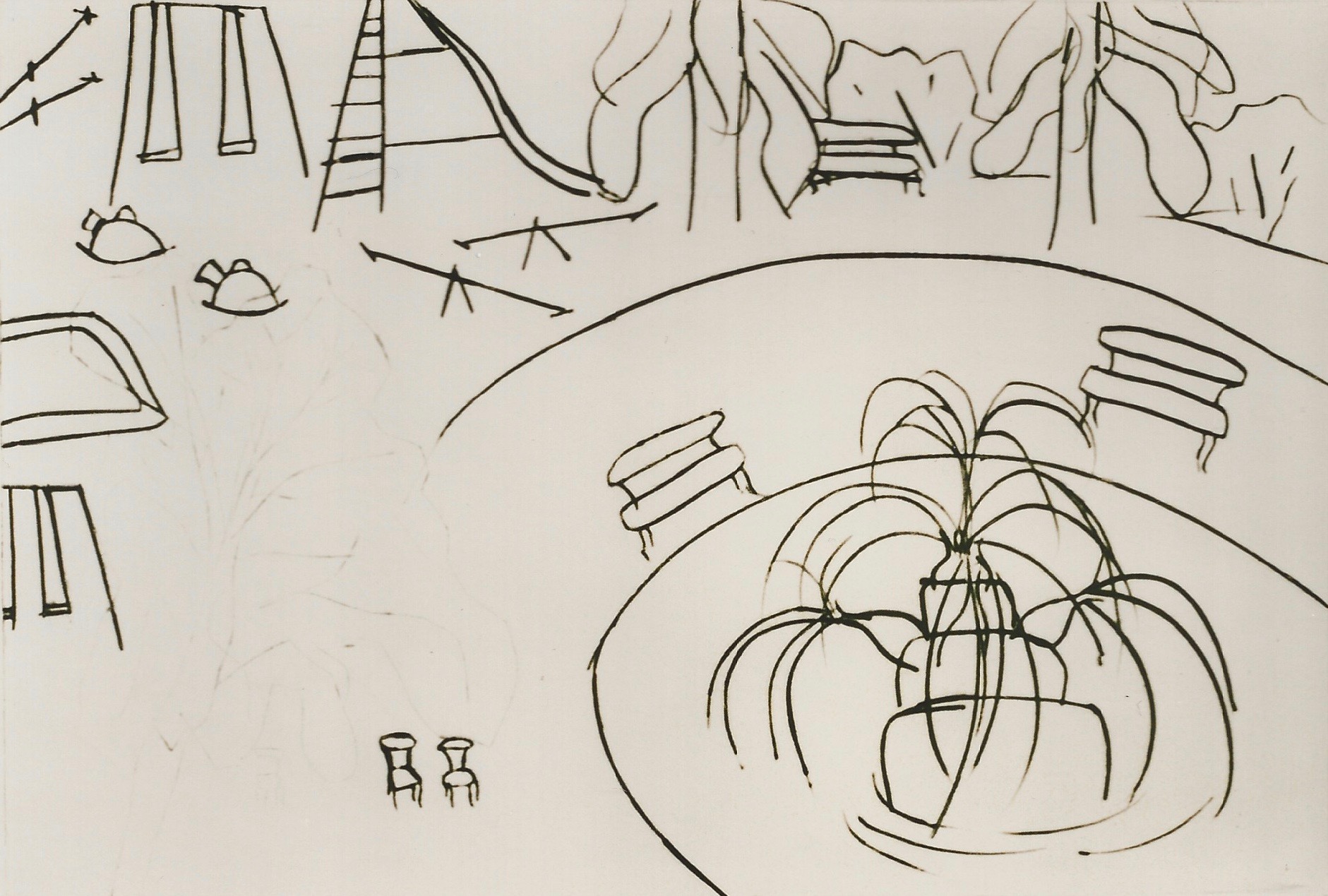
The graduation thesis of Yoni de Groot consists of two parts. One part is a diary-like reflection on art and life, written in the form of letters. The other part, which she calls "word images," contains sequences of words, actually with the same theme as the letters. They are emotional impressions of herself and the world around her in relation to her work. Her drypoint etchings also come across as "emotional impressions". That may sound strange after the above description of the etching "Zonnewende". From that description, you might conclude that this is a cool, purely formal registration of a random object. Only the title of the work disproves that suspicion. Through the title, the work takes on cosmic dimensions for me. And I see it. Top views of flowerpots become suns. A flowerpot becomes what it could contain: earth.
Zonnewende.
At first I did see the sun [zon] but not the turning [wende]. But a tilt is also a turning. The earth tilts and becomes sun. What is outside is actually also inside. Actually, a tilting of reality also takes place here, which offers the possibility not only to see this work differently, but also reality itself. Perhaps this was not the artist's intention at all, but the work touches me and broadens my field of vision, and I therefore do not believe that I am doing violence to her work with this interpretation. I could also imagine, thinking of "emotional impressions," that this work is about an internal solstice. What I like about this drypoint etching is that a purely formal approach is already interesting in itself, but it also offers the possibility to penetrate deeper and subsequently provides a view of a different reality or cosmos.
Zonnewende.
Source: "Verzameld in tijden van herkenning" [Collected in Times of Recognition] - Graduation Thesis 1991, Yoni de Groot.