part of SIGN 1988-2018 (WIP)
Thinking in Pictures
Robin Waart - 2009
Thinking in pictures
People take pictures — of a boy in Wellingtons, a pretty face, family, friends and foreign places, of Sunflowers, landslides, cityscapes or Mona Lisas, of things, in short, and moments worth remembering.
What I do is take pictures of pictures, collect movie stills of films both famous and unfamiliar, as if they were my own personal memories and recollections, though actually they are pre-recorded, re-distributed and reproduced — almost denying they are outtakes from something public, shared, collective, copyrighted, twenty-four pictures per second already. The stills are like quotes with(out) quotation marks.
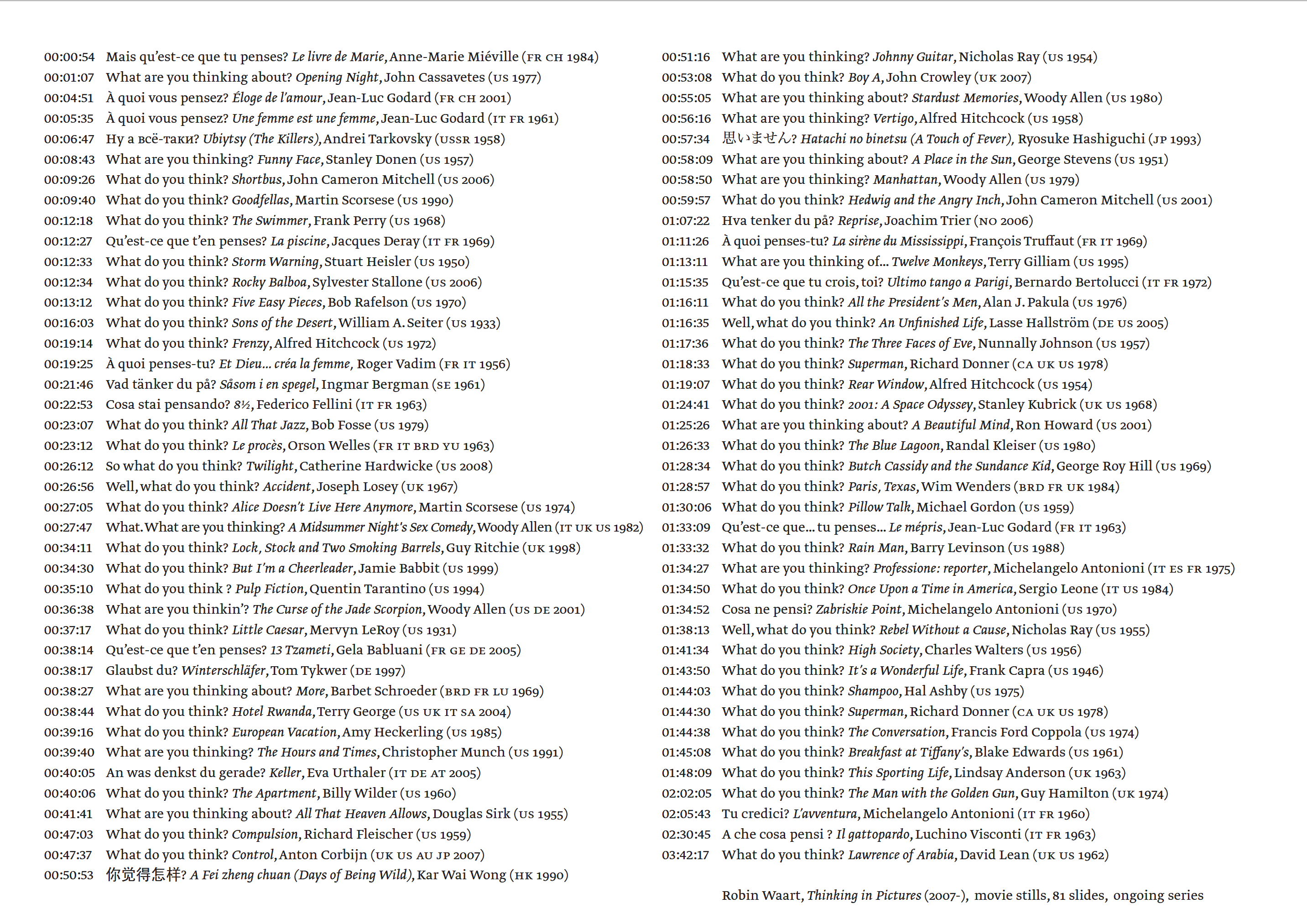
Because the words actually spoken a(f)t(er) the moment of snapshooting1 are visible and recorded through subtitles, they are citations in two ways:— as images cut out and filtered from film, on the one hand, as clear-cut textual references on the other. (A game of memory and recognition may evolve, evoking the viewers’ memories of the films themselves and the impressions they made, a game encouraged by handouts available at exhibitions, inventory lists citing –seemingly scientifically– each still’s source and particulars.)
The ‘What do you think?’ series consists of several hundreds of digital stills bound and brought together by one motif: recurring (para)phrases like ‘What do you think?’ and ‘What are you thinking (about)?’ — always questionmarked and always authorless, as, without exception, the actors’ mouthes are caught in the split second they are closed, or their lips are pressed, thus making them pertain to an incertain ‘what’ and some ‘you’ anonymous, which could be anyone, or anything, on the screen, but the viewer also. Either plural, singular. Or (none of) both perhaps.
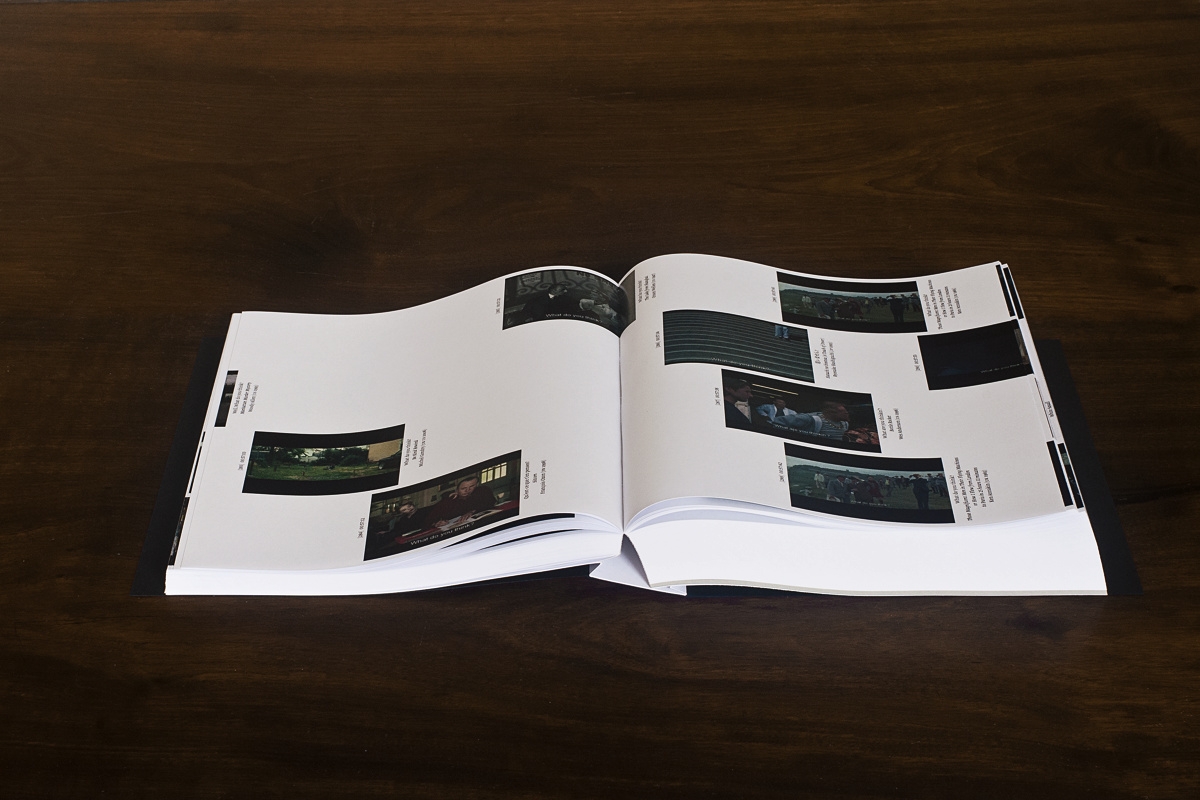
For each series or collection of stills an appropriate means of presentation is sought out, sometimes, even, a still is presented individually. The thinking stills are introduced to the public in two ways. An intended book publication will archive the first five hundred ‘thinking’ images. When exhibited in a gallery, museum or otherwise selections of eighty stills are shown in an out-of-date manner, by slide projection. To this purpose they are transferred from their (in)original to analog photographic media: shown through an old fashioned slide projector and on a collapsible screen — mimicking the way for decades holiday pictures were shown, or, in a school setting, (film) history lessons would have been taught.
Modern and digital devices, then, are employed to create something analog, old, less virtual, more material, more alive and prone to time — photosensitive, literally transparent, fading. Straightforward, even, since the machinery is audible and announces, clickwise, six seconds’ apart, when slides are switched. The screen, cheap folding chair and the projector’s buzz add to a sense of improvisation, outdated- or timelessness, perhaps.
In this –collapsible– setting things aren’t what they seem. They are (f)olded together (inducing strange, shady syntax, indeed). The ‘old’ is preceded by what is ‘new’ and technologically, more easily feasible, in a working process that avoids the traditional slicing of celluloid, dismisses taking pictures either in or of the movie theatre, unlike Hiroshi Sugimoto’s long time exposure photographs, Richard Prince’s and Sherrie Levine’s photo re-enactments and photos of photos — all I do is take and make them (at) home.
Again, things are turned upside down, inside out: dubbed and doubled, similar to the way impersonal questions and cinematical material may succeed in bringing about what is particular, private and universal, ‘that we speak with the words of others’, forgetting they are recollections ‘without owners’, and situations acted on a stage — in somewhat the same way rational inquiries like ‘What do you think?’ aren’t questions about some other person’s thoughts or thinking per se, but his or her feeling towards someone, something, some situation. They are rhetorical stop-gaps, phrasings, even translator’s t(r)ic(k)s. In it’s English form ‘What do you think?’ is literally used as a substitute for almost any conceivable foreign phrase and every thinkable state of affairs. Empathy, ‘projection’, translation and transference, go hand in hand, they take s(l)ides. Asking someone what’s ‘on his mind’ is more about not-knowing and emotion than knowledge or notions.
Simultaneously, through difference (visual) and repetition (textual) the stills provide an inventory of postures, gestures and moves, what one might be doing, the way one might look when asked or asking someone ‘what (s)he is thinking’, feeling probably — ultimately and continuously restating the difficulty, (im)possibility of ‘reading’ other people’s minds.
Still, on and in their new/old stage the ‘thinking’ stills become more pensive and ‘thoughtful’, and seem to start thinking again, thoroughly, for themselves, self-referentially, exploring the idea of thought, feeling, solipsism — even, especially, when the projector clicks, takes in and puts out an image: there is a moment of release, a blank in both time and space, on the screen,
the moment you stop seeing and start to think?
Robin R. Waart, February/2-21 March, 9 May 2009
Notes
1 A(f)t(er) the moment, like photos that most often don’t precisely catch the image you wanted to keep, but the instant right after.
Selected sources
Deleuze, Gilles, Différence et répétition. Troisième édition. Presses Universitaires de France (Bibliothèque de Philosophie Contemporaine), Paris 1976. (First edition: 1968.)
Grandin, Temple, Thinking in Pictures. My Life with Autism. Expanded Edition, Vintage 2006. (First edition titled:Thinking In Pictures: and Other Reports from My Life with Autism (1995).)
Pfaller, Robert, Die Illusionen der anderen. Über das Lustprinzip in der Kultur. Suhrkamp (Edition Suhrkamp 2279), Frankfurt am Main 2002.
Solana, Gemma/Boneu, Antonio, Uncredited. Graphic Design & Opening Titles in Movies. Index Book, S.L. (BIS Publishers), Amsterdam (c) 2007.
Wittgenstein, Ludwig, Tractatus logico-philosophicus. Tagebücher 1914-1916. Philosophische Untersuchungen. [=] Werkausgabe. Band 1. Suhrkamp (Suhrkamp Taschenbuch Wissenschaft 501, Frankfurt am Main 1984. (On ‘belief’ and ‘feeling’, cf. Philosophische Untersuchungen § 246, Werkausgabe I, pp. 357-368.)
Yampolsky, Mikhail / Joseph, Larry, P. (trans.), ‘Voice Devoured: Artaud and Borges on Dubbing’, October, vol. 64, Spring 1993, pp. [57]-77.