part of SIGN 1988-2018 (WIP)
UNTITLED
R Som Djien Tan - 1993
JUSTIFICATION
Our seeing is determined by our cultural-historical background; this limits us. By travelling and coming as much as possible into contact with other peoples, other cultures, I have tried to break through my western viewing habits.
In Nepal, for instance, I found out that there is a world inside me that is not separated by physical boundaries from the world around me. I tried to relive that experience in the Netherlands by going running. It seemed that my shadow moved independently of me, not part of me but still inseparable from me. While painting, I tried to capture that experience by making my shadow the subject.
An arduous process, in which, while painting, I tried to make contact with the part of myself over which I had no control. A logical sequel to this is the 'maize' series, inspired by the maize field of friends in Nepal. We stayed with these friends for about two months because I needed to heal from a liver infection I had contracted in Ladakh.
During that time, I watched the maize grow. Rest and introspection gave me a different perspective. The resulting image is only a part of the total that stretches endlessly.
At the same time, the need arose to approach form more expressively. I chose stones as a new starting form, because they can vary endlessly in form. For me, a stone embodies a symbolic eternity. In approaching this concept, the Western view fails because of the arrogance with which it assigns theoretical values to things. For me, a stone is not absolute; a stone comes into being, changes and decays. During our many treks through the Himalayas and other mountain ranges, it became increasingly clear to me that mountains too are not eternal. They are only eternal in our eyes. For me, the stones I paint, like the corn, are only part of a bigger picture. I isolate one to look at, I place a few side by side for composition, but reality continues.
Change, wear and growth of the mountain range are processes we faced during our journey through the Andes. It led me to paint glaciers and volcanoes because it is mainly these natural phenomena that cause the changes there. In doing so, I tried to bridge the apparent contradiction between impermanence and eternity, between action and rest, between beginning and end.
The subject, content and action of painting are becoming more and more in line with each other, as my thoughts have increasingly begun to align with my visual obsession. It became increasingly clear to me that processes are not bounded by a beginning and an end, that situations cannot be defined, and that structures cannot make order out of chaos.
The question of origins took us to China where I found a culture so strange, so different from the Western one, that I wonder if I can do anything with it. The search for the end and the beginning of the stone took us to the sands of the Gobi desert and the volcanoes of the Philippines.
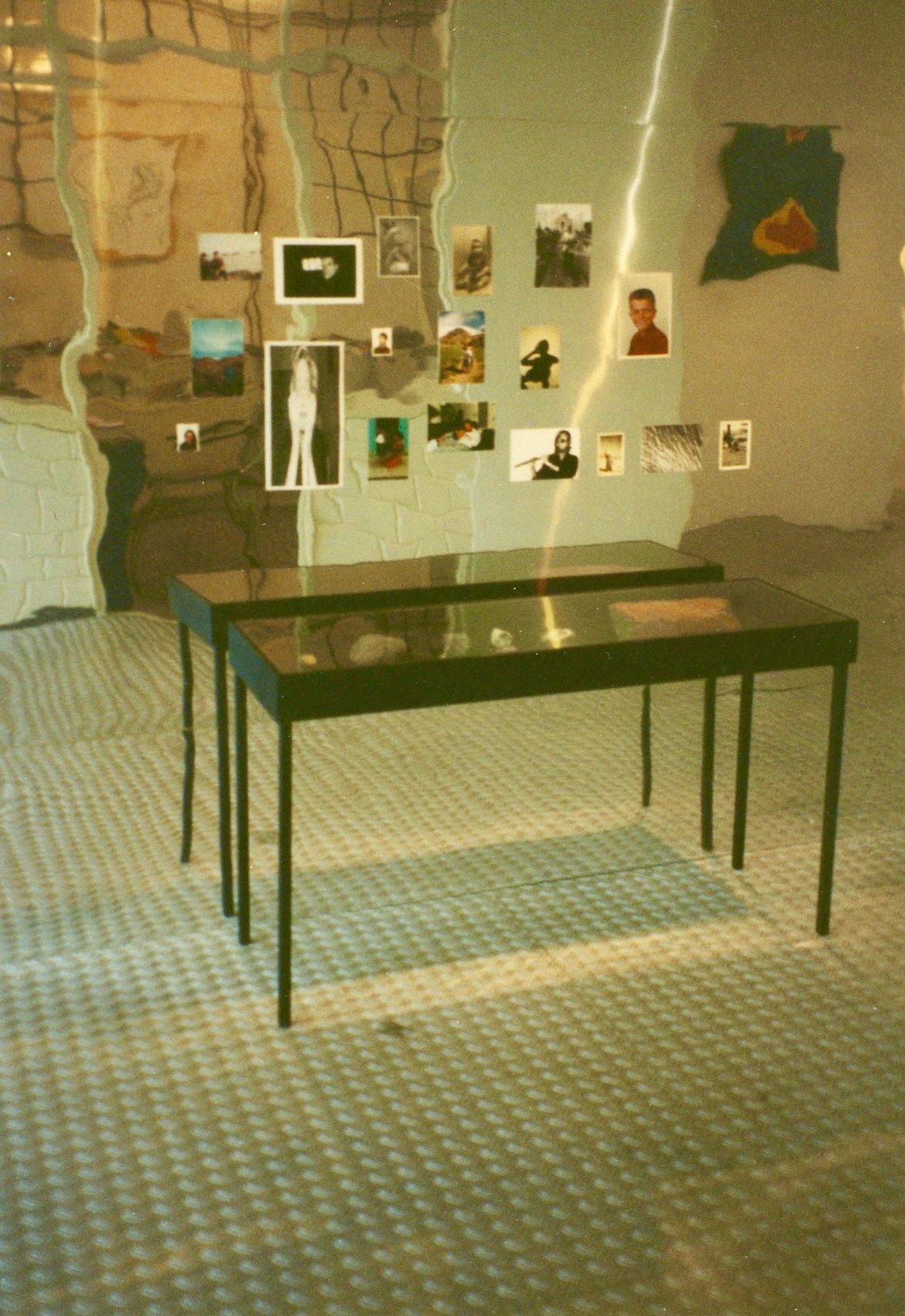
"LEENSTEENPROJECT" [BORROWED STONE PROJECT]
The installation consists of two parts: a display case with stones and a number of photographs that are attached to an existing wall. The display case is a rectangular box on legs, covered with a glass plate, eight centimetres high, the stones vary in colour, shape and size. The stones contain their own history, they have come into being, grown and been shaped by the elements. At a certain moment they became part of the persons who carried them with them, sometimes as a symbol of an event, a memory or just like that without any demonstrable reason. In any case, that one person kept that one stone with them.
The photographs are of the persons who supplied the stones for the display case, sometimes they are recognisable, then again not at all, here and there a photograph from childhood has been chosen. They are frozen moments from a process of change, the image can be read, it tells a story about the person; the analysis or likeness is not important.
The same applies to the stones that do or do not fit or belong with the person. The judgement is not important, it is about the sediment of the process of which it has been a part and of which it is still a part.
With thanks to the following persons who lent me a stone for this project:
|
Tom and Corry Been Frans Fransen Gao Fu Hong Nap Guldenaar Chris Hinze Maria B. Mast Claudia Mecklenburg Gustav Mecklenburg Peter Oosting |
Sita Pahari Arjo Passchier Jaquelien Sluis Aafke Sterenberg Deborah and Nader Tamannaie Kelly Travis Aafke van Veen Hanny van der Vlugt |
"LEISTENENPROJECT" [SLATE STONE PROJECT]
The object consists of forty paintings attached to slate stones in a wooden box. The box is fifty-two by forty centimetres, the slate stones protrude above the box and give the whole a height of twenty centimetres.
The acrylic paintings are applied to pieces of fabric of approximately fifteen by ten centimetres. The fabric is ragged at the edges because it has been torn (off). The forty paintings look all the same at first glance; they are blue surfaces with, fairly centrally, red stones surrounded by a yellow flaming edge. The red stones vary slightly in shape and size and the yellow edges, upon closer examination, are clearly all different in shape. The pieces of fabric are glued onto slate stones. The slate stones are thirty by eighteen centimetres and are placed leaning backwards with the longest side horizontal, one behind the other in the box, so that an effect of an archive box with system cards is created. The box is made of four thick planks, hewn from poplar. The bottom is a thin plate of the same wood. In fact, the box is only the carrier of the object and, in material choice and treatment, only intended to shape, accentuate and present the object.
The painted pieces of fabric come from a fabric of ninety by one hundred and ten centimetres. The large fabric was first painted and then torn into forty small pieces of fabric. The small pieces of fabric were then touched up and finally each glued onto a slate stone. Originally, the flaming stones belonged together on the same fabric. After an intervention which, through the tearing, did not affect the essential character of the woven ground, the stones were separated from each other. The same separation, of a large plate into smaller plates, took place with the slate stones. Here too, through the manner of intervention, the splitting, the essential character of the stone has not been affected. Both interventions actually emphasise the characters of the materials used. The small paintings with flaming stone on their slate carriers will be sold individually. The object will thereby fall apart and the individual elements will be further separated. A geographical dispersion will take place and each element will take its own place. The element, now having become an object, will enter into a reciprocal relationship with its new environment.
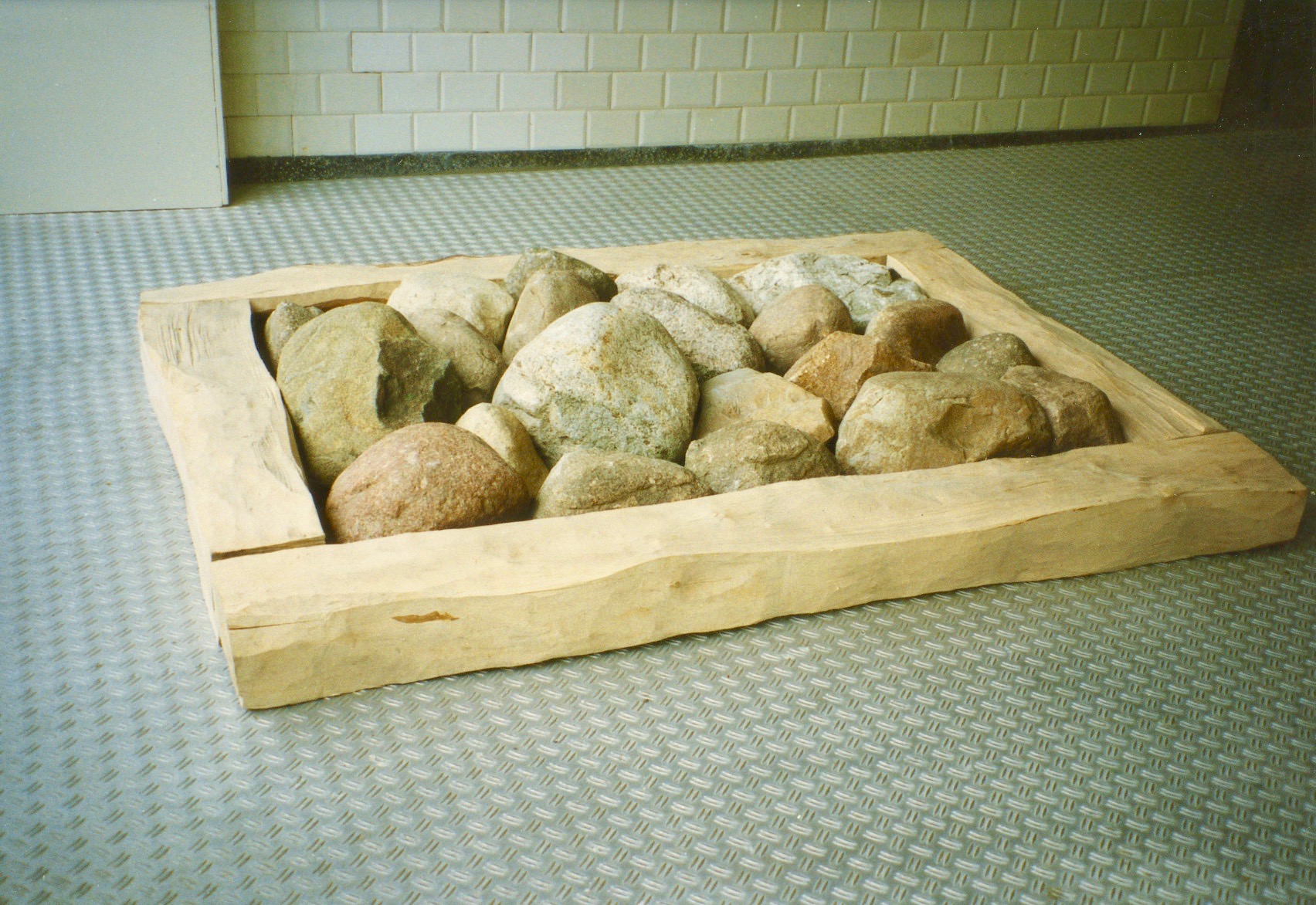
"ZWERFKEIEN PROJECT" [ERRATIC BOULDER PROJECT]
The installation consists of approximately twenty erratic boulders arranged in a rectangle enclosed by four beams. The whole lies on the floor and has a total size of two metres by one metre fifty-five, in height varying from thirty to forty centimetres.
The erratic boulders are clean and here and there some growth of lichens can be seen. They vary in shape and size from twenty to forty centimetres in diameter. The beams are split and hewn from a birch tree. The shape and growth pattern of the tree is still clearly visible, on some places bark is still visible.
The stones have a completely natural appearance, they are clearly formed by long-lasting glacial processes. The shapes are generally round due to the abrasive action of the ice in the glaciers. The enormous forces that have acted upon the stones are clearly visible in the large fracture surfaces present on some stones. The stones have come a long way, they have been shaped by the earth, they are a part of the earth itself. Due to the enclosed nature of the beams they are isolated from their natural environment. This is further reinforced by the way the beams are formed. The beams are damaged pieces of tree; it is not dead wood, but a tree modelled by human hands. Man (the artist) has manipulated one natural element into an instrument in order to subjugate the other natural element (the stone).