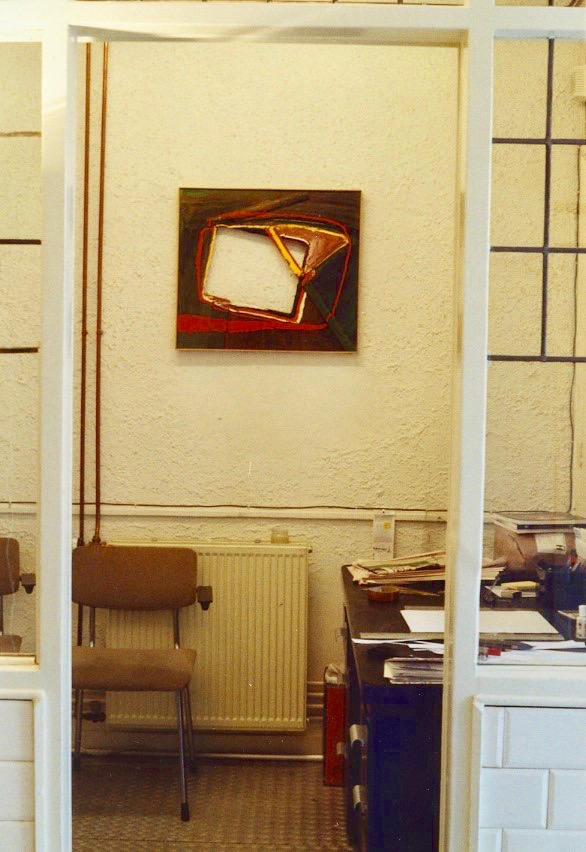
part of SIGN 1988-2018 (WIP)
EVERYTHING IS COLOR
Milena Dabić - 1989
Rudolf Arnheim, American art critic, once said that abstract art could never be a 'pure, unapplied form' without meaning. For Arnheim, every line had a certain indication and was consequently symbolic. According to his theory, abstract art, with its material expressions such as colour, rhythm and form, did not mean 'mental abstractions'. Needless to say, A's opinion is one of many, for the subject of art has always been challenge to endless discussions. For some, the essence of art seems so intangible that even its 'vagueness' can easily be questioned.
My main interest is in painting, and painting means colour. But I am also aware, that colour does not exist in a vacuum - on the contrary, it is strongly bound to form, rhythm and space of its own. It is a long time since painting ceased to be a 2-dimensional affair. According to Japanese culture, the essence of art (kokoro) is no more than a touch of breathless beauty, something fleeting and short-lived, in no way permanent and stable. Buddhism maintains that the world is inscrutable and deceitful and, therefore, so-called real reality cannot in fact be experienced because it is beyond our comprehension.
It is said that thought is far too complex to be fully expressed in any language. Perhaps art is the best language of our thoughts .....
Let's assume for a moment that the essence of art turns out to be some latent value, covered or veiled by various tangible layers. Let us suppose that colour is a very important part of this covering, which as such possesses an important property like that of fire, water and air.
If so, it would consequently be possible to enter colour, i.e. literally go inside it. Once inside, we would be able to reach values beyond material reality, such as the emotions and associations evoked by colour, or even the 'nothingness' that can be experienced in the absence of any reaction to colour or any other visual stimulus.
Gauguin believed that the use of colour was a form of magic or mysticism. His own colour possesses an inner power, which is at once musical and mysterious.
We all seem to cherish different representations of different landscapes; the varied forests and lakes of our imagination, mixed with the unique visions of our own Picassos, Chagalls and Vermeers. One day, our own death means one of the many deaths these painters died.
It was Leonardo who said that a paint-soaked sponge thrown against a wall would create a highly suggestive stain. We are so full of representations that we probably see in Leonardo's stain the forests and lakes of our imagination. And this is exactly what abstract art is all about, isn't it?
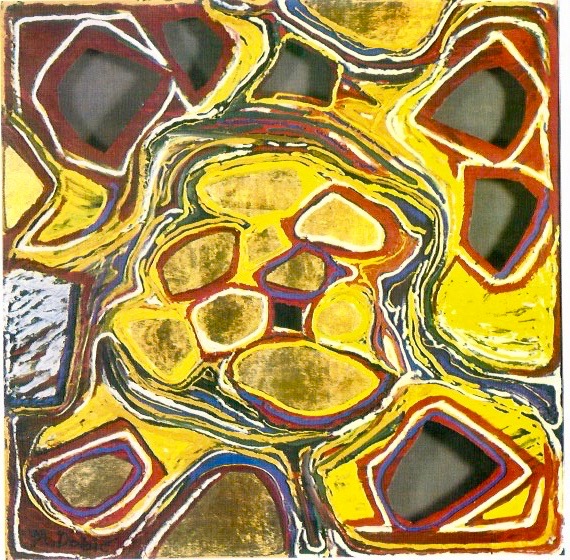
I love playing with them and enjoy the relationship they have with form, rhythm and their own space. A while ago, I wondered how I could merge a painted surface with the space around it - because paintings do not exist in a vacuum.
First, I started cutting holes in my paintings (to 'invite' the wall into my abstract compositions). Then I started 'building' my paintings out of wood and hardboard. This also gives me more opportunity to connect with the sensual texture of all the materials I use in my work.
For me, abstract painting is almost a way of life - perhaps the only way to endure the reality of an 'abstract' country like Poland and still remain in my right mind - which I hope I still am.